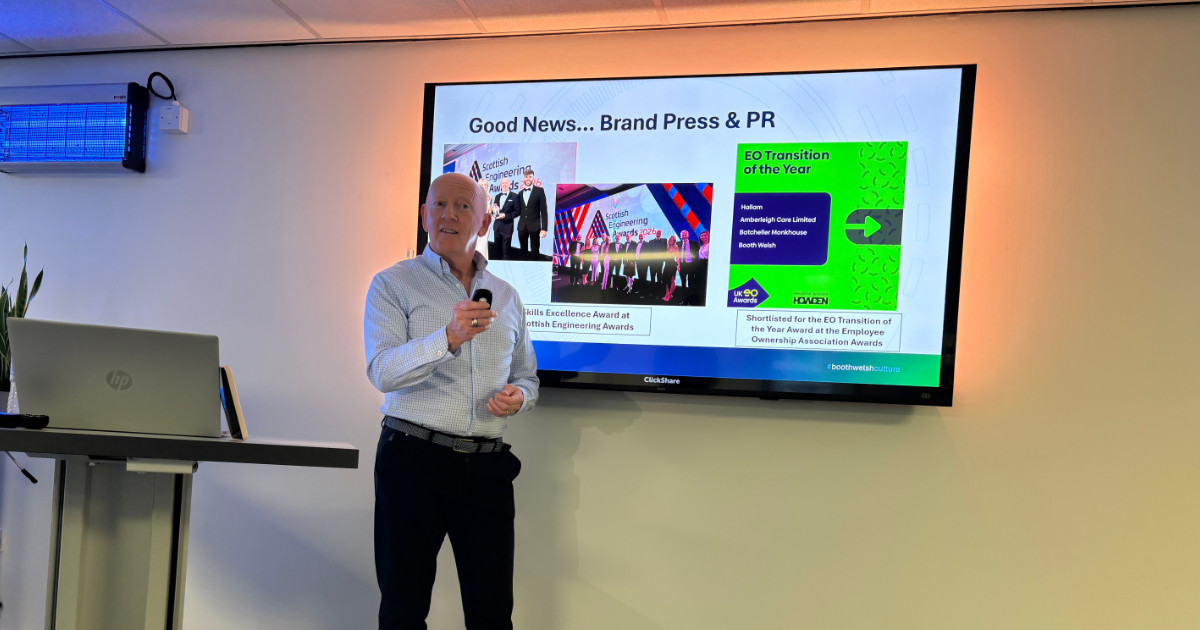

Effective communication is one of the cornerstones of successful employee ownership. While the EOT structure establishes employee ownership, communication helps employees understand their role in the business and its future. Last Friday, I attended the Booth Welsh Business Breakfast, which offered a strong example of this in practice.
Because people work across multiple sites, bringing everyone together is not practical, so those who can attend do so at the Irvine headquarters, while others join via Teams.
Managing Director Martin Welsh opened by explaining how the move to an EOT in October 2025 strengthened the company's profile. He said it had been a major factor in the company receiving several prestigious awards and shortlisting nominations. Visitors and customers also comment on the strength of its collegiate culture. He added that its commitment to giving back to the community, particularly in Ayrshire, is another important part of its identity. As a result, he and others from the business are often invited to speak at academic institutions, industry events, and organisations keen to understand its success.
He then updated employees on business performance. They were reassured to hear that the company is performing well, with a healthy pipeline of future work and an ambition to grow revenue by 30% over the next four years.
Martin emphasised that employees are the company's best ambassadors. He said the EOT did not bring a revolution to Booth Welsh, but an evolution of what was already there. The business had already moved through several ownership models, from family ownership to multinational acquisition, management buyout, and finally the EOT. This route was chosen to reinforce the company's employee-centred culture and allow everyone to share in its success.
Martin outlined recent initiatives. The C.A.R.E.S. values brand was introduced in preparation for the EOT and reinforces the company's values of:
Martin said these are often dismissed as "soft ", but argued they are fundamental capabilities and a key part of what makes Booth Welsh different.
Martin then updated everyone on other recent initiatives:
The KUDOS programme encourages employees to recognise one another for living the CARES values. So far, 118 KUDOS awards have been given, with monthly champions rewarded.
There are also ‘Ask the Board’ initiatives, where employees can directly ask questions to the leadership team around company strategy and performance.
There was also a presentation on the new benefits offering, Perkbox, which gives employees access to significant discounts across a range of retailers and hospitality outlets.
Martin closed by telling employees that the EOT builds on the company's already strong culture. Booth Welsh is now the employees' business, and the ambition is to grow it for the long-term benefit of everyone.
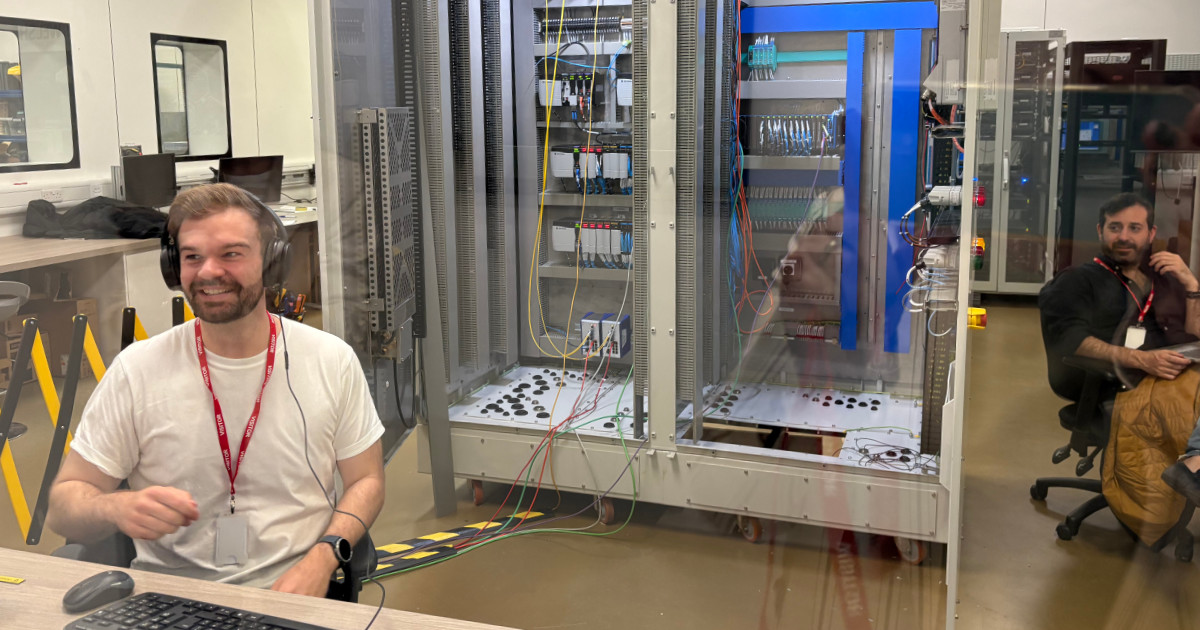
The Business Breakfast format is particularly effective because it turns employee ownership from a legal structure into a lived organisational practice. Rather than relying on emails, newsletters, or occasional updates, it gives employees a regular opportunity to hear directly from leadership, understand the context behind business decisions, and ask questions in an open forum. That matters in an EOT because ownership only has real value when people feel informed enough to act like owners. The hybrid approach, with employees attending either in person or via Teams, also shows that inclusion is being treated as a practical priority rather than an aspiration. In that sense, the format does more than communicate information: it builds trust, visibility, and a stronger connection between day-to-day work and the long-term direction of the business.
In an employee-owned business, communication of this kind is not a supporting extra; it is part of what makes the model effective. It helps employees see the bigger picture, understand how their contribution supports performance, and recognise that ownership carries both a stake and a responsibility. Booth Welsh's approach therefore offers a useful example of how communication can strengthen culture, improve engagement, and make employee ownership feel real in everyday working life.
Scotland based employee ownership specialists.